Language models and real-time search agents
1. Introduction
In this report I’m going to analyze, from a close and critical perspective, how the arrival of artificial intelligence (AI) is rapidly transforming the world of SEO, and specifically how this will affect our website (BECOSAN.com). It’s important to clarify from the outset that we are in the middle of a constant process of change, full of uncertainty, where new technologies and user habits are evolving non-stop.
My main goal is to present the current situation in a neutral and clear way, identify emerging trends, and propose a strategic path we can follow — knowing that this path will be full of adjustments and that we don’t yet have all the answers.
This report is aimed at stakeholders with a basic understanding of marketing, and at my colleagues in the marketing department. I also hope it will be useful for other professionals in the industry looking to better understand the challenges and opportunities posed by AI integration in SEO.
In the final section I offer my conclusions as well as some ideas for implementation and testing.
2. Current Context: Key Players in AI and Search
To understand how artificial intelligence is impacting SEO, we first need to distinguish between two key elements: language models (LLMs) and the interfaces or agents that allow interaction with them in real time.
Language Models (LLMs)
LLMs (Large Language Models) are models trained on massive volumes of data drawn primarily from the internet: websites, books, forums, articles, social media, etc. Some of the most well-known are:
- GPT-4 (OpenAI)
- Gemini (Google)
- Claude (Anthropic)
- Command-R (Cohere)
- Mistral, LLaMA, DeepSeek, etc.
These models are powerful, but they have an important limitation: their knowledge is limited to the date on which they were trained. Although some are periodically updated, they primarily work with historical information, not real-time data.
This is key when we’re talking about businesses or services where timeliness matters.
AI Interfaces and Agents with Internet Access
On the other hand, there are tools that act as agents or interfaces that allow users to interact with these models, adding a layer of live search through APIs.
I like to call them AI Agents, and they are what people commonly know simply as AI or ChatGPT.
In other words, they don’t just generate text — they can query updated results in real time.
Some examples:
- ChatGPT (with browsing enabled via Bing)
- Gemini (integrated with Google Search)
- Perplexity (its own engine with multiple sources (rumored to be Bing))
- You.com, Komo, Andi, among others
Some of these agents already integrate complementary sources like Reddit, X (Twitter), Google Scholar, financial portals, or specialized databases. But in our case — given our industry, type of content, and user profile — the most relevant ones remain Google and Bing, as they concentrate the majority of B2B industrial searches in Europe.
Google’s Move: SGE
In this context, Google has reacted quickly with the launch of its AI mode known as SGE (Search Generative Experience), which will integrate AI-generated answers directly into the traditional results page. The idea is to offer users a more complete and useful answer without them having to leave Google.
This change is crucial because it modifies the way content is presented in search, directly affecting traffic to websites. It’s no longer just about ranking well, but about understanding how our content is incorporated into these new generative results.
Super-agents and New Concepts
Beyond the known agents, so-called “super-agents” are emerging, such as AutoGPT or Project Mariner by Google . These systems go beyond answering questions: they can execute complex actions, automate workflows, and make decisions without direct user intervention. Some concrete examples of what they can already do or will soon be able to do include:
- Completing a full purchase without leaving the conversation.
- Sending an email without opening any mail application.
- Filling out and submitting contact forms directly from the conversational interface.
Although they are still in early stages, they have the potential to completely change the way we interact with products, services, and content on the internet.
3. Evolution of SEO in the AI Era
Over the past few years, SEO has evolved from a focus on exact keywords, to one based on broader topics, and finally to a model entirely centered on the user and their intent. (Yes, for Google the user has always been the center and the most important thing…)
With the arrival of conversational interfaces (AI agents), searches are becoming longer, more natural, and more specific.
This favors what we know as long-tail keywords, but at the same time makes them much harder to track from an analytical standpoint.
Many traditional keyword reports no longer reflect how people actually search.
Another key point is the lack of clear standards. Each platform is implementing AI in its own way, and for now there is no common framework. This creates uncertainty about what gets indexed, how it’s analyzed, and which signals each system values.
Changes in Search Behavior
A clear example of how habits are changing: before, someone would search for “industrial floor repair company” on Google and analyze several results. Now, they directly ask ChatGPT or Perplexity something like: “Which company do you recommend for repairing a concrete industrial floor in Spain with a guarantee and experience in the sector?”
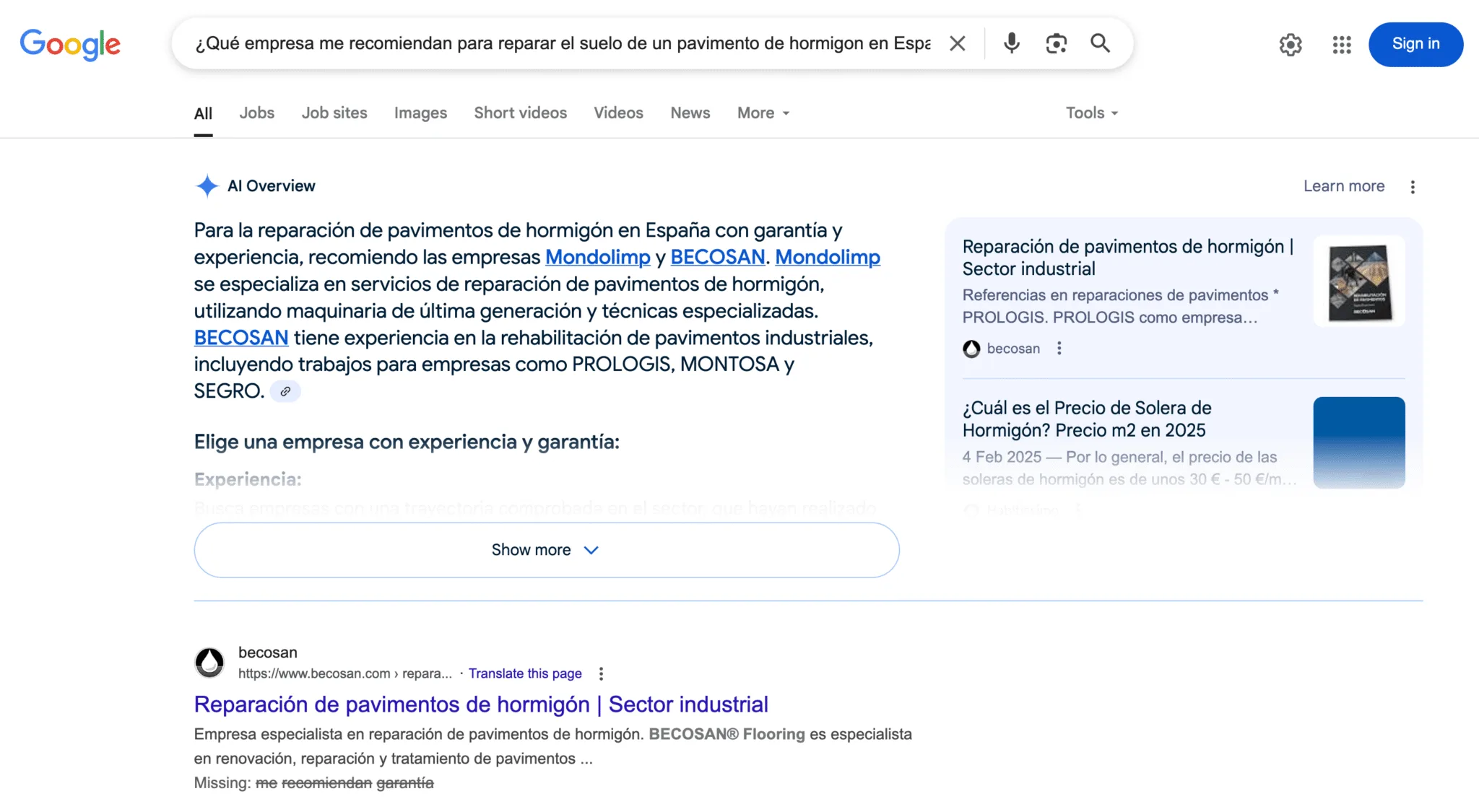
This reflects a shift in approach: users expect concrete, personalized, and fast answers without needing to click through multiple links.
Google.com as the New Standard
Google has decided to unify all versions of its search engine under the google.com domain. Official sources for this news here (Google blog and Search Engine Land )
This might seem like a minor detail, but it’s worth paying attention to. This move could have a direct impact on multilingual and multiregional SEO strategies, especially on websites like ours that operate in several languages. Although it’s not a topic we’ll address in depth here, we shouldn’t lose sight of it.
Whether it’s for maintenance reasons, to simplify their structure, or because they truly no longer need such granular segmentation in their indexes, it’s something we need to keep on our radar.
Could Google perhaps be able to understand that you offer services in multiple markets even if you don’t have a website in that market? Is it possible that (most likely) it already takes your content into account, regardless of the language, to feed its models? If so, should we focus our efforts on the main language and “forget” (from an SEO perspective) the other languages?
These are open questions that come to mind and that perhaps some readers might want to contribute to.
Google’s Guidelines on the Matter
That said, Google has recently reaffirmed the same thing it has been saying for years: that it prioritizes useful, user-centered content created with expertise. In its May 2025 publication “Succeeding in AI-powered search ”, they highlight three key ideas:
- Focus on content that demonstrates experience, expertise, and trust (EEAT).
- AI doesn’t replace traditional search but complements it.
- Good SEO practices remain valid in generative AI environments.
In summary, we’re facing a changing landscape where understanding the user well and adapting with agility will be more important than ever.
4. Limitations of Traditional Analytics
One of the biggest current challenges in SEO has nothing to do with content or search engines, but with how we measure results. Traditional analytics, based on cookies, sessions, and traffic sources, is increasingly limited and in many cases is starting to lose real utility.
On one hand, privacy regulations (such as GDPR) and many browser settings are blocking third-party cookies by default. This directly affects tools like Google Analytics, which rely on those cookies to measure sessions, traffic origin, or conversions.
On the other hand, the emergence of new AI-based search interfaces (AI Agents) is generating a type of traffic that isn’t always reflected in our reports. If a tool like ChatGPT shows a summary with our website as a source, and the user doesn’t click, that visit simply doesn’t exist in our metrics.
This creates two problems:
- We don’t know how many times we are mentioned or consulted from conversational agents.
- We lose traceability of interactions that do provide value, but that don’t generate clicks or sessions.
Additionally, it’s becoming increasingly difficult to identify with certainty which traffic comes from traditional search engines and which comes from AI-assisted engines. Channel attribution is becoming more diffuse, and relying solely on Analytics data can lead to incorrect conclusions.
This doesn’t mean that analytics is no longer useful, but rather that we need to be clear about its limitations. There are signals we’re missing, and we need to be attentive to new ways of measuring, such as identifying emerging crawlers, analyzing indirect behavior patterns, or cross-referencing data with Search Console to detect drops in impressions that previously generated clicks.
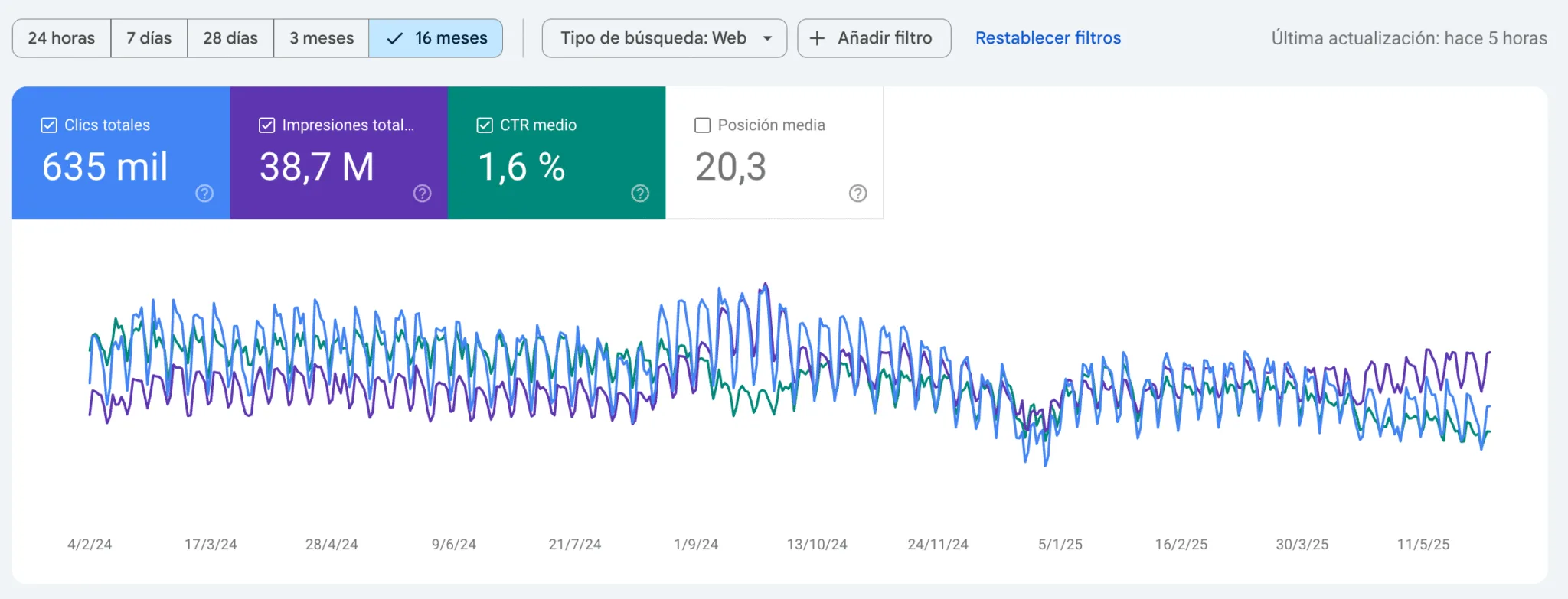
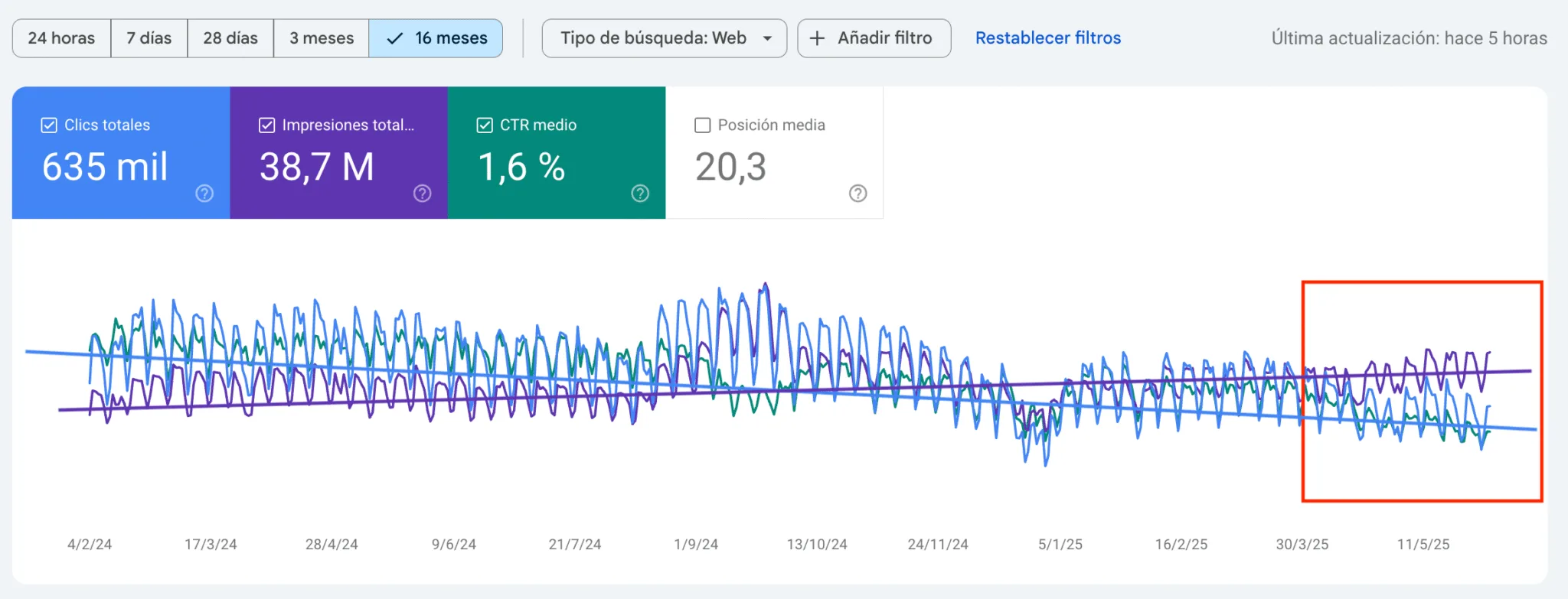
In this second chart, you can see more clearly how, although impressions (purple line) remain relatively stable — with some seasonal variation — clicks (blue line) are progressively declining. You can see how we’ve gone from a situation where the click line was above the impressions line, to the opposite: impressions clearly surpass clicks. This divergence marks the famous “crocodile jaws,” and it’s one of the most evident indicators of the “zero-click” effect.
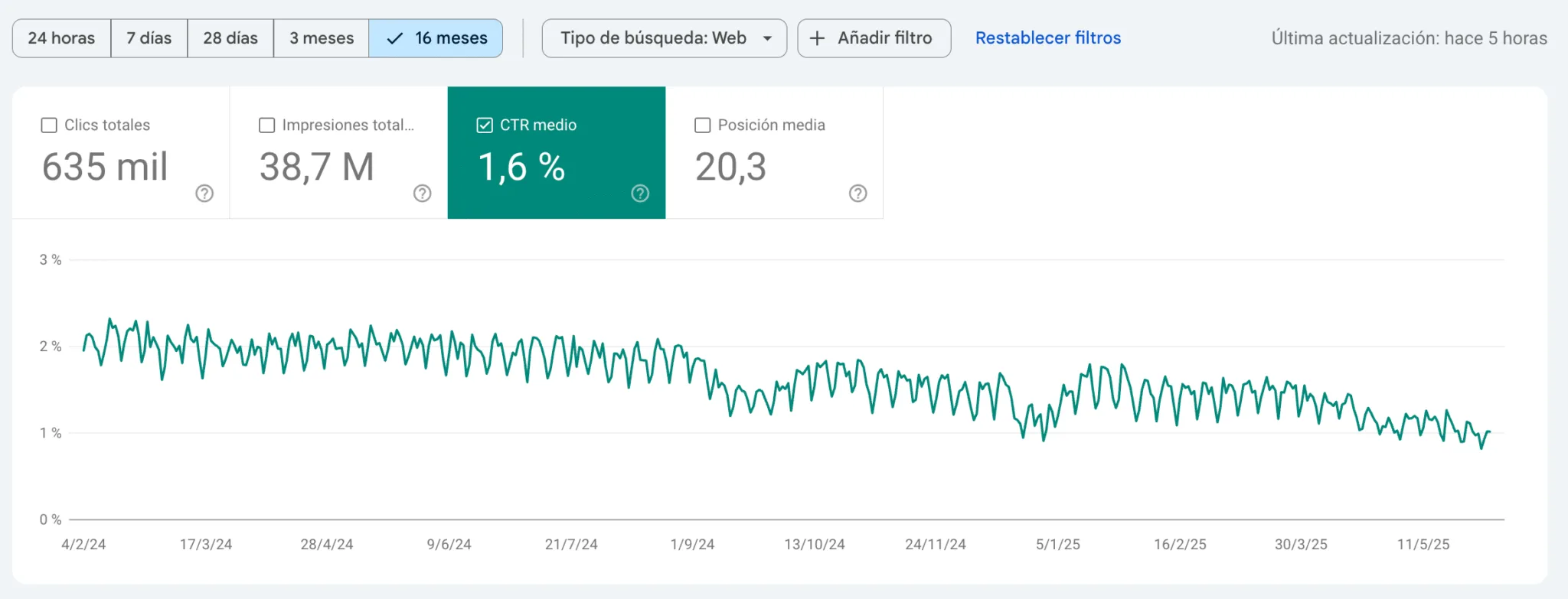
If we look at the average CTR (clicks/impressions) over the last 16 months, we see a downward trend: it has gone from values near 2% to levels close to 1%. This decline reinforces the idea that, although we continue to appear in searches, fewer and fewer users are clicking.
5. How Does This Affect Us?
In our specific case, much of the traffic we receive through SEO is informational. Many users arrive at our website looking for solutions, comparisons, guides, or answers to specific problems related to industrial flooring.
And this is where the current changes have a direct impact.
AI-powered engines are beginning to answer many of those questions directly from their own interface, without the need for clicks.
This means that, even if we continue to appear as a reference, the user may never actually visit our website.
It’s no longer enough to rank well: we also need to understand how our answers are being presented and whether AI is interpreting us correctly.
Do we see this reflected in our data? Yes.
We’ve already discussed this with the Search Console charts. We see how impressions remain stable, but clicks are falling. CTR has also dropped progressively over the last 16 months. This points to a clear change in user behavior. We’re being seen, but not clicked.
Is everything negative? Not necessarily.
Our website has been generating useful, specialized, and user-centered content for years. Furthermore, we have clear signals of experience, authority, and trust (EEAT), both through the brand’s track record and through published content and real case studies. All of this plays in our favor against weaker competitors or sites that have taken a purely SEO-driven approach without building their digital reputation.
In fact, in this new scenario, it’s likely that many niche competitors — who relied on ranking for informational articles — will lose visibility, while we continue to be considered by AIs when recommending services.
It’s likely that the total number of leads will decrease, although we’re still pending the quarterly count, but the new leads are probably more qualified than before. I’m becoming convinced that this will be the trend: fewer leads, but more qualified.
A new challenge is that many of these recommendations leave no trace. There’s no click, no session, but there can be influence or even subsequent conversion. And this forces us to change how we analyze and evaluate the real impact of SEO.
6. What Path Do We Take Now?
Our current strategy is based on three pillars: continuing to strengthen our EEAT, optimizing the technical side and opening up to other search engines, and allowing ourselves to experiment in controlled environments.
The goal: adapt without losing focus on what truly matters.
My personal opinion is that Google was forced to launch its AI mode (Gemini integrated into Search) as a direct response to the popularity of other agents like ChatGPT. I believe they know the product is still immature, but they had to move fast to avoid losing market share. The result is that in a short time Gemini AI will be the default search experience for many users, which forces us to be prepared.
As of today, SEO still works as it always has: although now Bing also needs to be taken into account, not just Google — and our pages continue to rank based on the usual signals. What has changed is how that content is presented to the user and what portion of the traffic actually reaches our website.
Actions we are already taking:
- We’ve started optimizing for Bing as well, since many AI agents rely on it.
- We are going to migrate our hosting to a more “AI-friendly” solution, one that doesn’t block legitimate crawlers that may be used by these engines.
- We are stopping the creation of informational content, something we had already paused months ago.
- We are starting a systematic review of current content using AI tools to validate whether the message is being interpreted correctly (who we are, what we offer, who we target). A detailed action plan is pending.
- We are going to simulate searches as a user would in these new conversational agents to analyze whether they recommend us over the competition. If they don’t, understand why. This exercise will be key to understanding the new customer journey.
- We are going to prioritize “fresh” content such as case studies, news, or real projects, over generic texts designed solely for SEO.
- We will increase the link-building budget. Although in our context it had lost importance, it’s now relevant again to reinforce the perceived authority by these new systems.
7. Future Ideas to Explore
In the medium term, AI agents won’t just answer questions — they’ll complete entire actions: they’ll be able to purchase products, submit forms, or contact companies without the user ever visiting the website. This changes the rules of the game.
That’s why, beyond immediate actions, there are ideas we’re considering that could make a difference in the coming years:
- Don’t forget that right now, these agents are based on the best-ranked results from Google and Bing. Positions come first, then agents use our information.
- Focus on the metrics that truly matter to us: leads.
- Possible new metrics: trying to identify crawlers and count visits from each of them. This used to be dismissed, but it may now have value.
- Keep an eye on new AI search players in each of our markets. We’ve been very focused on Google, but we can’t rule out the emergence of local winners like Yandex in Russia or Baidu in China. It’s possible that some AI tool could become more relevant in a specific market.
- Shift our content strategy not only toward SEO, but toward reinforcing brand authority and sending clear signals of professionalism, specialization, and reliability.
- Ask ourselves whether in the future it will be necessary to translate an entire website or whether it will be enough to clearly tell AI that we offer X service in X market/country, and prove it credibly. (How?)
- Strengthen direct contact points. Instead of letting AI agents handle everything, offer a clear and human avenue of support: visible phone number, help chat, accessible WhatsApp. Like being the expert store clerk who helps you choose, but online.
8. Conclusion: Clarity in Uncertainty
What lies ahead is uncertain, yes, but not necessarily negative. The industry is changing and the way people search for information is no longer the same as it was a few years ago. But that doesn’t mean SEO is dead or that everything we’ve built so far has lost its value.
We still have a solid website, authority in our niche, a user-centered approach, and a brand that generates trust. That’s the ideal starting point to adapt with calm and good judgment.
The key will be to stay attentive to how AI agents evolve, to observe how search habits change, and above all, to remain useful and visible wherever our potential customers are looking for us. There will be many tests, errors, and adjustments, and it’s normal that some questions still don’t have answers.
The important thing is that we’re already moving in the right direction: fine-tuning our strategy, taking care of the technical side, strengthening our image, and preparing for new scenarios. This stage can be a great opportunity for those who adapt well.
Explore, learn, make mistakes, and try again. We don’t have absolute certainties, but we do have a clear roadmap: keep being useful, visible, and recommendable on any platform, search engine, or conversational assistant that comes along. With calm, but without standing still.